Objectives and priorities
The pathway starts with the needs, priorities and outcomes the organisation wants to achieve.
A more technical account of how educational objectives, organisational capacity, local relationships and European cooperation are connected within one coherent pathway.
Explore our model ↓Every pathway starts with the organisation’s objectives. Through educational co-design, Submeet translates them into activities, methods and connections aligned with the expected outcomes. The aim is not to deliver a single experience, but to generate learning, expertise and relationships that can continue over time.
The pathway starts with the needs, priorities and outcomes the organisation wants to achieve.
Activities, methods, settings and partners are defined in relation to the expected outcomes.
Learning is transferred into the organisation and becomes expertise, tools and reusable capacity.
The connections developed can evolve into new mobility activities, partnerships and European initiatives.
The infographic distinguishes the educational and institutional ecosystem from the operational service network, and shows how organisational and ecosystem capacity contribute to the same outcome.
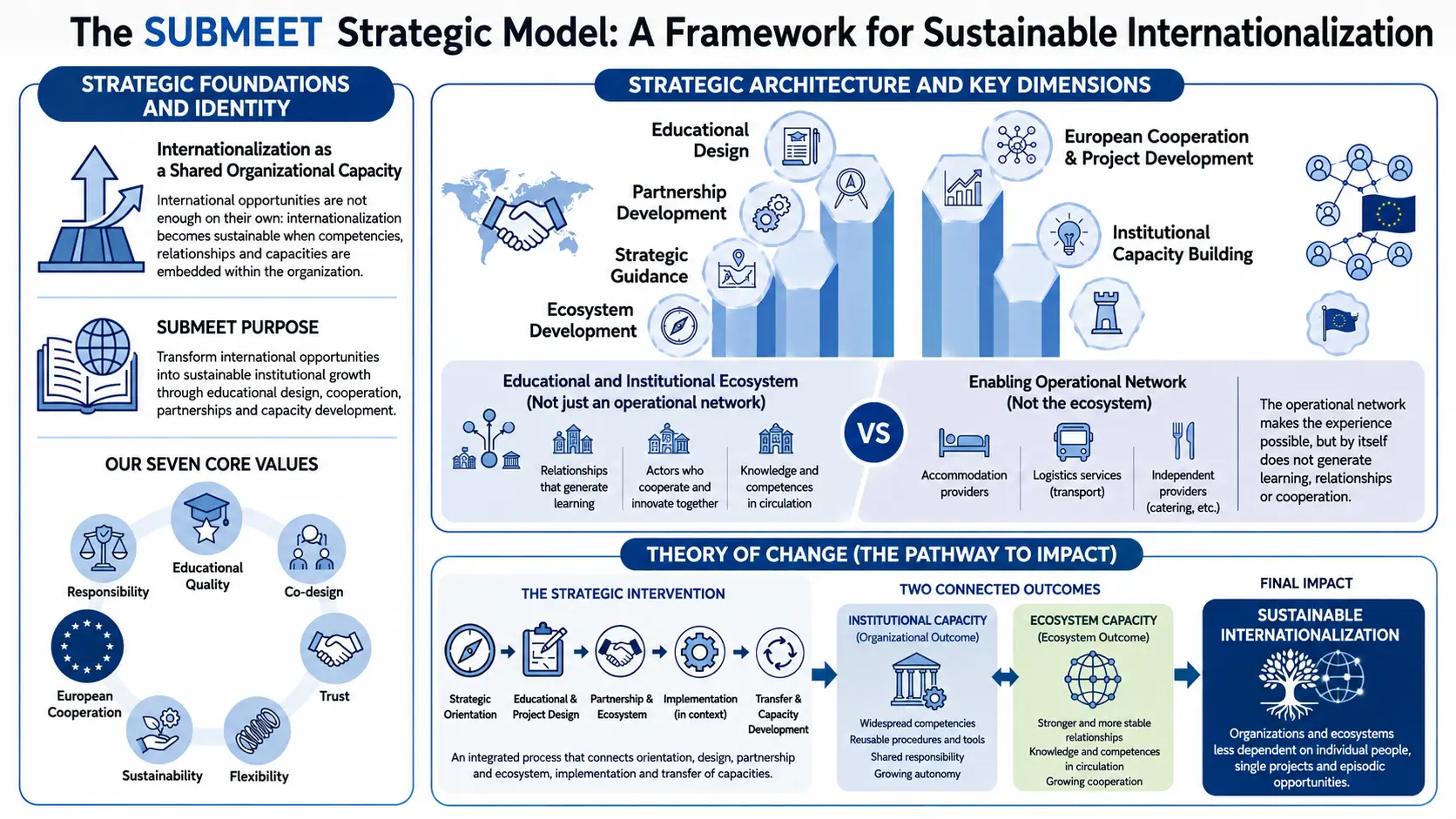
The model treats internationalisation as a shared organisational capacity: it becomes sustainable when competences, relationships and capacities are embedded within the organisation. SUBMEET’s purpose is to turn international opportunities into sustainable institutional growth through educational design, cooperation, partnerships and capacity development.
The seven core values are educational responsibility, co-design, trust, quality, European cooperation, sustainability and flexibility. SUBMEET integrates strategic guidance, educational design, partnership development, European cooperation and project development, ecosystem development and institutional capacity building.
The educational and institutional ecosystem comprises relationships that generate learning, actors who cooperate and innovate, and knowledge and competences in circulation. It is distinct from the enabling operational network — accommodation, catering, transport and other independent services — which makes the experience possible but does not, by itself, generate learning, relationships or cooperation.
The intervention connects strategic guidance, educational and project design, partnerships and ecosystem, implementation in context, and the transfer of capacities.
These two outcomes converge in sustainable internationalisation: organisations and ecosystems become less dependent on individual people, single projects and episodic opportunities.
Educational and project value and the practical delivery of mobility require different actors, with distinct functions and responsibilities.
Schools, VET providers, Adult Education organisations, businesses, institutions, associations and European partners contribute to educational design, learning and the development of cooperation.
Accommodation providers, restaurants, transport operators and other independent suppliers make mobility activities and international programmes practically possible. The operators involved understand the characteristics of Erasmus+ mobility and the organisational needs of international participants. Agreed rates help identify sustainable solutions that are, wherever possible, compatible with the budget available for each project.
Submeet’s role Submeet facilitates access to reliable, cost-conscious solutions suited to participants’ needs. Each provider remains independent and responsible for the services it delivers.
The framework guides the work, but content, responsibilities and relationships are defined around the organisation’s needs and starting point.